

.svg)

.svg)
.svg)
.svg)
.svg)
.svg)
.svg)
An investment has meant a general meeting decision, a loan and years of payback. This article walks through what heating optimisation as a service means for a housing company in practice and what the board should find out before deciding.
Why housing company heating costs are so high
According to Statistics Finland, maintenance costs in apartment block housing companies averaged 6.17 euros per square metre per month in 2025. Heating takes around a fifth of apartment block maintenance costs (22% in 2021), which makes it the largest single cost item.
At the same time, the price of district heating has risen several years in a row. Averaged across the networks in Finnish Energy's price statistics, district heating for a typical apartment block cost about 82 euros per megawatt hour including taxes at the start of 2020 and about 107 euros at the start of 2025. The price therefore rose by about a third. When energy prices rise, every unnecessarily heated degree costs more. City-by-city prices and the differences between them are covered in District heating prices 2026: a city-by-city comparison.
A district heating bill has two parts: an energy charge based on consumption and a fixed capacity charge set by the property's heating power demand. Both can be reduced, but they require different measures.
A large share of heating costs comes from unnecessary consumption. The most common cause is overheating: in many housing companies the indoor temperature is a couple of degrees above the recommendation, and residents often do not notice. According to Motiva, lowering an excessively high room temperature by one degree reduces heating costs by about five percent on average. The recommended room temperature in apartments is about 21 degrees. Energy saving in a housing company often starts right here.
The underlying reason is often that heating is controlled by outdoor temperature alone, not by what actually happens in the apartments. Outdated settings and an unbalanced heating network raise the bill without benefiting anyone.
Three ways to reduce heating costs and what they require
Heating costs can be influenced in many ways. The options differ above all in how large an investment they require and how quickly they are in use.
| Approach | Investment | Payback | Decision | Time to deploy |
|---|---|---|---|---|
| Structural renovations (windows, insulation) | Large | Long, often over 10 years | General meeting | Months |
| Replacing the heating system (e.g. ground source heat) | Large, often a loan | Several years | General meeting | Months |
| Optimising the existing system | No own investment when bought as a service | Starts immediately | Typically the board | Weeks |
None of these is automatically the right or wrong choice. Structural renovations and replacing the heating system make sense when the building is approaching major renovation age anyway or the system is at the end of its life. Optimising the existing system suits a situation where the housing company wants to start reducing heating costs now without a renovation budget. These do not need to be set against each other: optimisation is often a sensible first step that can be taken before larger renovations become relevant.
What heating optimisation as a service means for a housing company
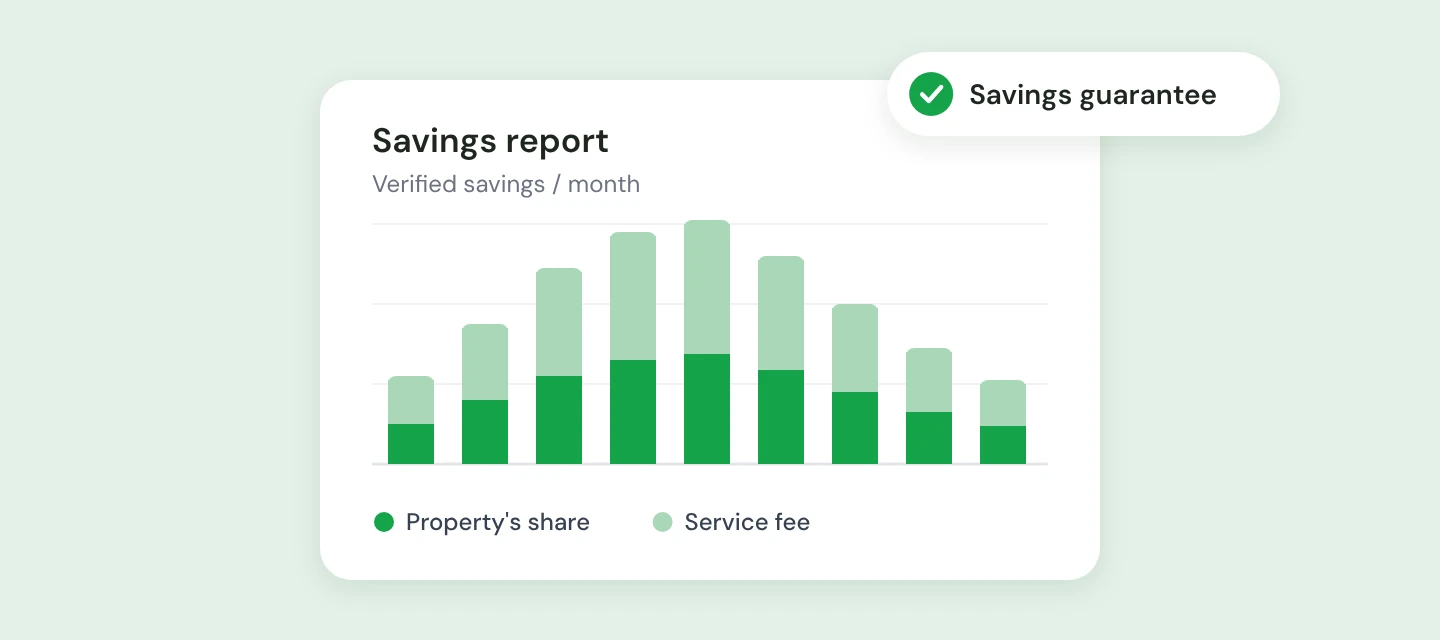
Optimisation as a service is a model where the housing company does not buy equipment or make an investment, but buys an outcome. The service provider installs the necessary technology at its own cost. The housing company pays an agreed share of the savings actually achieved.
The model typically includes a savings guarantee: if there are no savings, there is no bill. The risk of the investment paying off therefore sits with the service provider, not the housing company. This is the key difference from buying equipment, where the housing company pays up front and carries the risk of whether the purchase delivers the expected benefit. The contract period in a savings-as-a-service model is usually several years, because the equipment is paid back from the accumulating savings.
The model resembles the ESCO service known in the energy sector, where an outside party carries out an energy-saving investment and payment is covered by the resulting savings. In practice there is a difference. ESCO projects are typically built around a specific energy-saving investment or renovation. Either the service provider or the housing company itself may finance them. Heating optimisation as a service is a continuous service in which the housing company neither buys equipment nor takes a loan. The service provider owns and maintains the equipment for the whole contract period. Deployment is light and requires no renovation.
For residents the change is small. In practice the necessary equipment is installed in the heat distribution room and remotely read temperature sensors in the apartments. There is no renovation and no disruption to living. The service removes overheating and evens out temperature differences between apartments, so residents see a more even indoor temperature and the housing company a smaller heating bill.
How savings are measured and verified
This is the question every board asks: how do we know the savings are real? The principle is straightforward.
The baseline is taken from the housing company's past consumption. Because the weather varies from year to year, consumption is normalised for weather conditions so that a cold or mild winter does not distort the comparison. Measured consumption is then tracked and compared with the weather-normalised baseline.
Payment is based on an annual savings forecast and is reconciled once a year against the savings actually achieved. This keeps the housing company's budgeting predictable and the final payment matches what was really saved. If there are no savings, the savings guarantee means nothing is paid for the service.
What the board should ask the service provider
The questions below work for any supplier. A property manager can send the list straight to the board to support the decision.
- What happens if there are no savings? Check whether the contract includes a savings guarantee.
- Who owns the equipment during the contract and who is responsible for maintaining it?
- What happens to the equipment and the service when the contract ends?
- How are the savings verified and how often are they reported to the board?
- Does the current district heating controller need to be replaced, or can it be kept?
- Can the board decide on the purchase itself? Because no investment is made, the board can typically decide, but it is worth checking your own articles of association.
- How long is the contract period and how is the service fee determined?
It is worth asking for the answers in writing. A good service provider answers these clearly without the housing company needing to understand the technology in detail.
How Voltria does this
Voltria offers properties two services that work on the model described above, with no investment from the property: Intelligence and Hybrid.
Intelligence optimises the existing heating and suits practically all district-heated housing companies, typically buildings with around 15-35 apartments. Hybrid includes the same optimisation and also adds an alternative heat source alongside district heating. District heating stays in place and always works, so security of heat supply is not reduced. Hybrid is most profitable in larger buildings, as a rule of thumb housing companies with more than 35 apartments.
In most cases the existing district heating controller can be kept. If the controller is too old to connect, replacing it is included in the service price. Both services come with a savings guarantee. Payment is based only on the savings actually achieved.
Which service suits your housing company depends on the consumption data and the current state of the heat distribution room. Read more about the services on the Our services page and from the housing company's point of view on the housing company page.
Next step
Want to know how much of your housing company's heating costs could be cut? Request a quote and we will calculate a savings estimate from your consumption data and suggest the most suitable option. You can also estimate the savings potential yourself with the savings calculator.
.svg)
.svg)
.svg)
.svg)
.svg)
.svg)
.svg)